Analysis
The Abiy Regime Does Not Change Its Genocidal Plan on Tigray, it changed its tactics

The war on Tigray from November 2020 to late 2022 was marked by large-scale killings, ethnic cleansing, mass rape, starvation, and the obstruction of humanitarian aid. Independent documentation shows that the deliberate denial of basic services — including famine-level deprivation — was used as a tactic of war against the Tigrayan population and has been described by scholars and human rights bodies as evidence of crimes against humanity and genocidal intent. According to estimates, about 600,000 civilians died during this period due to direct and indirect causes of the conflict, including mass mortality from food insecurity and blockade conditions.
Even where formal hostilities appeared to end with the Pretoria Cessation of Hostilities Agreement in November 2022, the structural conditions that inflicted massive harm on Tigrayans have persisted — and in some respects intensified — in new forms.
The 2020–22 Campaign: Background to Continued Policies
The United Nations and independent monitors documented that the authorities in Addis Ababa and their allied forces engaged in the deliberate denial of access to basic services and humanitarian assistance, leaving vast portions of the Tigrayan population in what were described as “dire conditions” during the war. A UN human rights commission found reasonable grounds to believe that starvation and the denial of humanitarian access were used as a method of warfare.
Since the Pretoria framework was signed, public services — including banking, telecommunications, and the issuance of identity documentation — have remained severely restricted or arbitrarily provided, and ID cards essential for access to rights and services were not being issued or renewed as of April 2024.
The continuation of these structural deprivations long after the end of major fighting underscores that the strategy has shifted tactically, not substantively.
1) Training and Arming Forces to Attack or Intimidate Tigray
A central feature of the post-Pretoria period is the continued preparation of forces hostile to Tigray.
Armed groups and militias are being supported and trained outside Tigray, particularly in the Afar region and in the occupied areas of Western Tigray, with the intent of deploying them against Tigray. These developments suggest preparation for armed pressure or renewed offensives.
Even after the Pretoria Agreement was meant to bring peace, armed clashes and incursions by groups identified by Tigray authorities as hostile have continued along Tigray’s borders — especially in Afar and the southern extensions of Tigray — amid repeated allegations that these forces operate with federal support or acquiescence. In fact, the regime aided with drone strike attacks against Tigray by the armed militia it supports and trains in Afar.
The preparation and positioning of such forces along Tigray’s borders creates persistent insecurity and projects lethal threat against Tigrayan communities. This represents a continuation of violent pressure by state-aligned and non-state actors.
2) Use of Federal Bureaucracy to Deny or Restrict Access to Services
The structural denial of basic civil and public services remains one of the main instruments through which the strategy of attrition continues.
Despite commitments under the Pretoria Agreement and international pressure to restore services, key elements of daily life remain obstructed. Federal budgetary transfers have been suspended or restricted, and infrastructure essential to public services — including fuel, banking, health care, and civil service payroll — has been deliberately limited. According to statements from the TPLF, federal fuel restrictions lasting nearly ten months paralyzed transportation, economic activity, and essential social services such as ambulances, health facilities, water, and sanitation.
Similarly, access to banking services and economic functions remains constrained. Bank accounts linked to Tigrayan institutions and businesses were blocked, disrupting operations and employment for tens of thousands.
Other services that underpin human survival — electricity, telecommunications, and civil documentation — remain intermittent or dependent on federal permission even after the cessation of major military operations. This reflects a broader pattern in which denial of services is used deliberately as a mechanism of control, exclusion, and attrition.
A striking example is the National Digital Identification Program (Fayda). According to official communication from the Tigray Interim Administration, what was presented as a cooperative program was used to strip Tigrayans of their identity and register them under other regional categories, particularly in Western and Southern Tigray. This constitutes demographic engineering, a hallmark of genocidal processes under international law.
3) Suppression of Humanitarian Visibility and Aid
Since mid-2021, international humanitarian bodies have described restrictions on aid entry into Tigray as a de facto blockade, severely limiting lifesaving assistance to millions of civilians and requiring special permission for the movement of cash and supplies.
Even after the Pretoria Agreement, significant bureaucratic hurdles remained. Humanitarian access was not fully restored, and many areas — particularly from late 2023 onward — were classified as “hard to reach” or “partially accessible,” with movement constrained by continued insecurity and administrative impediments.
Humanitarian monitors have noted that even where aid enters Tigray, it remains grossly insufficient, with large numbers of displaced people in major IDP centers receiving little or no sustained support. Reports from local actors further indicate that independent fundraising and aid efforts by communities and civil society have faced threats and pressure, sharply limiting direct support to starving populations.
These patterns do not reflect bureaucratic inefficiency. They are consistent with an ongoing strategy of controlling life-sustaining resources, prolonging suffering, and minimizing external evidence of catastrophe.
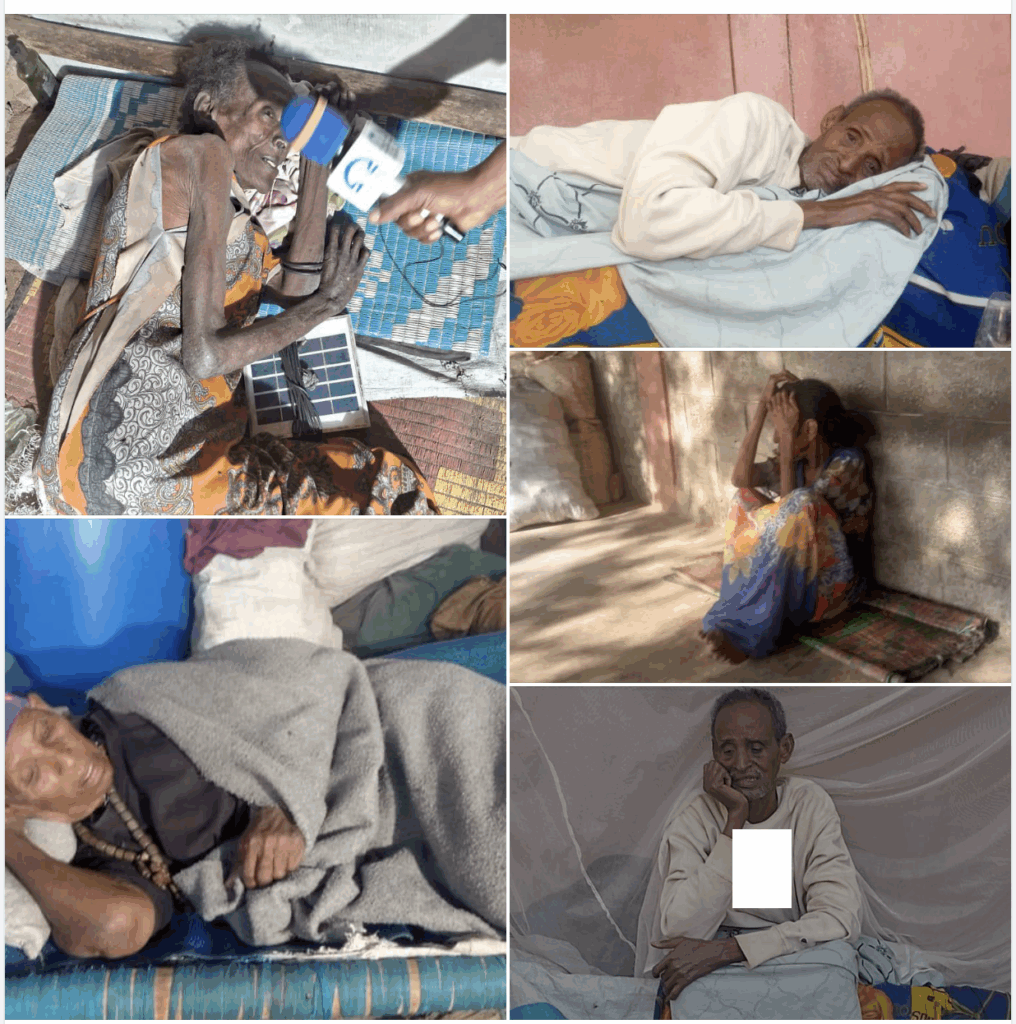
Recently, reports and images of severely malnourished internally displaced Tigrayans, including from the Hitsats IDP center, emerged once again. In response, authorities in Addis Ababa:
- denied the authenticity of the images,
- labeled them politically motivated, and
- ordered fundraising efforts to stop.
They further demanded that all collected funds be surrendered to state control. Yesterday, the transfer of the funds was carried out under the pretense that it was initiated by the organizers themselves. No sane person believes that this money — or any portion of it — will reach the starving IDPs whom the regime displaced from their homes and continues to bar from returning, instead ensuring their slow death through starvation and perilous migration.
This is not merely cruelty; it is strategy. Starvation is most effective when it occurs unseen. Blocking independent aid and criminalizing solidarity ensures that Tigrayans die quietly, without witnesses.
Conclusion
The historic violence inflicted on Tigrayans during 2020–22 has not given way to a normalization of civil life, but to a recalibration of tactics that continue to inflict grave harm. The training of hostile forces along Tigray’s borders, the systematic denial of essential services through federal bureaucratic levers, and the suppression of effective humanitarian relief together illustrate a persistent strategy of attrition and exclusion.
These are not accidental administrative failures. They are deliberate acts with predictable lethal consequences, recognized in international reporting as part of a continuum of abuses that include the denial of aid and services as tactical weapons. These actions must be understood not as remnants of a concluded conflict, but as ongoing measures that perpetuate the suffering and marginalization of Tigrayans.